

Setting your budget is the easy part, staying within it takes serious discipline and restraint. Jon from Hylands Homes reveals the best ways to ensure you only spend what you intended to.
1) Keep Your Budget At The Top Of The Wishlist
When discussing your initial plans with your builder you should make it clear what you want to achieve and what the available budget is. Any plans that are prepared must be capable of being built within that budget. Keeping that information to yourself could well mean your plans end up being amazing but unaffordable. Nobody wants to waste good money on a design that never gets built.
2) Choose Designers That Know The Costs
While it is true that just about anyone can call themselves a builder, good builders will have registered with a trade association that will carry out a vetting process to ensure they are operating correctly. In our experience, the best of these is the NHBC (National House Building Council) because their checks are ongoing, rather than a one-time inspection.
Look for the logos of well know associations on the builders’ paperwork and check that they are registered using the relevant online check-a-member services. Lots of dodgy builders use the logos illegally. Examples below.


3) Just In Case The Worst Happens
Every builder should have Public and Employers Liability insurance as a bare minimum. Without these policies in place, the existing parts of your home and property are at risk. You should also check they have Contract Works insurance to cover damage to the new work they are building.
4) Dig the Dirt on Their History
Has the builder ever been declared bankrupt or been disqualified from a company? You can search for this information here. While some builders that have gone bust may have done so through no fault of their own, some nefarious builders will buy a load of cheap work, take lots of deposits and then disappear. You can usually see a pattern of this when doing credit history checks.
5) Happy 10th Birthday
The best sign of a good builder is how long they have been trading for. Of 100 startups, 80 will go out of business within 5 years! Of the remaining 20 companies, 16 will go bust before the company reaches 10 years old. That equates to just 4% of builders going the distance.
Longevity usually means they are doing something right.
6) Want Something Done, Give it to a Busy Person
A sure sign of a company that probably doesn’t do great work is that they are available to start your project within a few days. The best builders will have order books that are full and will generally have 3 or more jobs running at the same time.
7) 40 Minutes or Less
Look for local builders that operate in your area. Keep an eye out for their advertising boards on other sites around where you live. When I say local I’m talking about a builder that is based within 40 mins of your home. Having several jobs on the go in the same area makes for efficient management and the builder (or one of their team) can quickly and easily pop over to sort out any issues between sites.
8) Lines of Communication
How does the builder plan to keep you up to date with the progress of the job? Ask to see what systems are in place to ensure things don’t get missed. At the very least, a group chat between all the decision makers will help to avoid breakdowns in communication. Look for a builder that utilises software to manage their sites and clients.
9) Cheaper Alternatives
Does the builder specify everything you are expecting to get fitted within their quotes? If not, then you could end up with something entirely different from what you thought you were getting. This may be done to save some costs while still charging you the full rate. Ask to see an example quotation that lists models and colours to ensure you’re going to get what you are paying for.
10) The Dreaded Added
Being VAT registered or not can be an indication of the type of work that your builder does. Registration is compulsory when turnover is more than £85,000 within any 12 month period. Considering that a couple of small extensions would put a builder over that threshold very quickly. If the builder isn’t VAT registered then perhaps they aren’t doing larger jobs on a regular basis.
11) Payment in full
Most reputable builders will ask for a small deposit to book the dates into their calendar to cover the cost of the administrative and pre-construction paperwork. However, if you hear a builder asking for payment in full or even a large proportion of the cost before starting the project then avoid them at all costs. While a builder shouldn’t necessarily bank roll your project you should expect to have a payment schedule set up with payments due at specific milestones of the build.
12) Legal Contracts
A builder that does not employ the use of a build contract is to be avoided at all costs. There are far too many unforeseen issues that can crop up and cause major problems to not something in writing that explains what will happen in these scenarios. A contract will specify the client and builder obligations in various circumstances and you will need this should you want to have a leg to stand on.
13) Get Your Hi Vis and Hard Hat On
One of the best indicators of how a builder operates on site is to go and see a current site they are working on.
- Is it a mess?
- Is it safe?
- Is it secure?
- Are their site signs up?
- What does their customer think of them?
- What do the neighbours think of them?
- Inspect the work. Is it neat?
14) Pick Up The Phone
Once you think you have found yourself a good builder, ask for some references from past customers. Go and see the finished work because what one person will happily accept, may not be to your standards.
15) Download Our Free Checklist
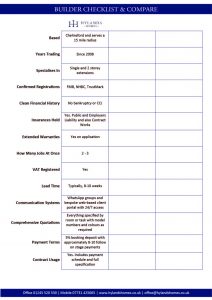
Want a printable “How to choose a builder” checklist to help compare your builders? Click here to download our free builder comparison checklist.
Do you know the 7 questions you must ask a builder BEFORE signing a contract to avoid delays, over spend and poor workmanship?
Download our free 18 page guide to find out the 7 must ask questions plus a checklist on what your contract documents should include.
